Have you ever wondered how your phone knows your face, how YouTube suggests videos you might enjoy, or how Google Maps finds the quickest route when you’re travelling? These things may seem normal today, but there is something interesting working behind them: Artificial Intelligence (AI).
AI has quietly become a part of our everyday lives. Whether we’re shopping online, watching movies, chatting with virtual assistants, or making online payments, we use AI in many ways without even noticing it.
A few years ago, artificial intelligence sounded like something from a science-fiction movie. Today, it’s helping students learn, professionals work faster, businesses understand customers, and people manage their daily activities.
So, let’s understand what AI actually means and how it makes our everyday lives easier.
What Is Artificial Intelligence (AI)?
Artificial Intelligence, commonly called AI, is a technology that allows machines and computers to perform tasks that normally require human intelligence.
In simple words, AI helps machines understand information, learn from data, recognize patterns, and provide useful results.
For example, when you ask ChatGPT to write an email, use Google Assistant to set a reminder, or unlock your smartphone with face recognition, you’re using AI.
The main idea behind AI is simple: make technology smarter so people can save time and complete tasks more easily.
10 Ways AI Is Useful in Daily Life
You might be surprised by how many everyday activities depend on artificial intelligence. Here are ten common examples.
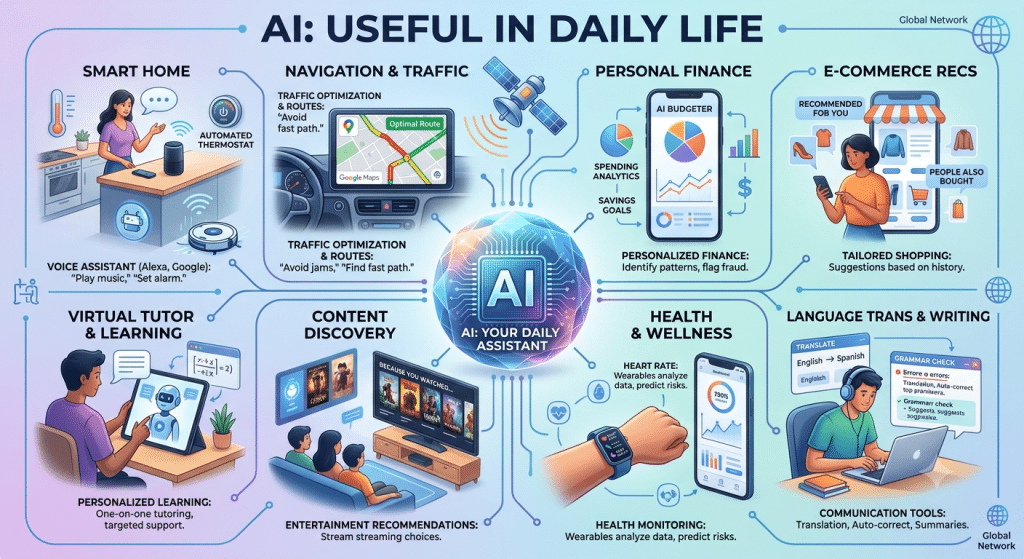
1. AI Makes Smartphones Smarter
Think about how many times you use your smartphone every day. From taking pictures to sending messages, AI helps improve many of these activities.
Features like face recognition, voice assistants, smart camera settings, and predictive text use AI technologies.
For example, when you take a picture, your phone can automatically adjust brightness, improve image quality, and recognize objects in the frame.
Even when you’re typing a message, your keyboard suggests the next word. It may look like a small feature, but it saves time and makes communication easier.
2. AI Makes Online Shopping Easier
Have you ever searched for a pair of shoes online and then started seeing similar products everywhere on shopping websites?
That’s one way AI works in online shopping.
Platforms such as Amazon and Flipkart use AI-powered recommendation systems to understand customer interests and shopping behaviour.
Based on your searches, previous purchases, and browsing activity, they suggest products you may like.
This makes shopping more convenient because customers can discover relevant products without spending hours searching.
3. AI Helps Students Learn Better
Learning something new is not always easy. Sometimes students struggle to understand complicated topics or find the right study material.
AI tools are making learning more flexible and accessible.
Students can use tools like ChatGPT to understand difficult subjects, improve grammar, prepare for interviews, and practice new languages.
For example, if a student doesn’t understand a topic in mathematics, they can ask an AI tool to explain it using simple words and examples.
AI can also help teachers prepare quizzes, lesson plans, and study materials.
However, students should use AI to improve their understanding rather than simply copying its answers.
4. AI Is Helping in Healthcare
Healthcare is another area where AI is making a positive difference.
Doctors and healthcare professionals deal with a huge amount of information every day. AI can help them analyze medical images, identify patterns, and support medical research.
For example, AI-powered systems can assist doctors when examining X-rays and MRI scans.
Some health and fitness applications also use AI to analyze sleep patterns, physical activity, and heart rate.
Of course, AI cannot replace a qualified doctor. Its role is to support healthcare professionals and help them make better-informed decisions.
5. AI Makes Banking and Payments Safer
Today, most people use mobile banking, UPI, and online payment applications for everyday transactions.
But have you ever wondered how banks identify suspicious transactions?
AI helps banks analyze transaction patterns and identify activities that may indicate fraud.
It is also used in customer support chatbots, credit risk analysis, and banking services.
For example, if a transaction looks unusual compared with your normal spending behaviour, a bank’s security system may flag it for further checking.
This helps financial institutions improve security and provide faster customer support.
6. AI Makes Travelling More Convenient
Imagine travelling to a new place without knowing the roads or traffic conditions. It could be difficult, right?
Applications like Google Maps make travelling much easier with AI-powered features.
They analyze traffic information, estimate journey times, and suggest alternative routes.
For example, if your regular route has heavy traffic, Google Maps may suggest another road to help you reach your destination faster.
AI is also being used in traffic management, driver-assistance systems, and the development of self-driving cars.
7. AI Controls What We See on Social Media
Have you noticed that Instagram, Facebook, and YouTube often show content related to your interests?
If you regularly watch fitness videos, you may start seeing more workout tips, fitness creators, and healthy lifestyle content.
This happens because social media platforms use recommendation systems to understand what users may find interesting.
AI analyzes signals such as your likes, comments, viewing history, and interactions to personalize your feed.
It also helps platforms detect spam and identify certain types of harmful content.
However, spending too much time watching recommended content can become a habit, so it’s important to maintain a healthy balance.
8. AI Is Making Our Homes Smarter
Imagine turning on your lights, playing music, or checking the weather just by speaking a command.
That’s what smart home technology makes possible.
Devices like smart speakers, voice assistants, smart televisions, and intelligent security systems use AI to make everyday household activities more convenient.
For example, you can ask a voice assistant to set an alarm, play your favourite song, or remind you about an important meeting.
Some smart home devices can also learn your preferences and automatically adjust certain settings.
9. AI Improves Our Entertainment Experience
After a long day at work, many of us enjoy watching movies, listening to music, or scrolling through entertaining videos.
AI helps make these experiences more personalized.
For example, Netflix recommends movies and shows based on your viewing habits. Music platforms suggest songs and playlists according to your listening preferences.
AI is also used in video editing, gaming, animation, and image creation.
It helps people discover content they may genuinely enjoy instead of searching for everything manually.
10. AI Helps Us Work Smarter
One of the most useful applications of AI is in our professional lives.
Whether you’re a student, digital marketer, business owner, or office employee, AI tools can help reduce repetitive work.
For example, digital marketers can use AI to find content ideas, research keywords, write social media captions, and prepare blog outlines.
Office professionals can use AI to draft emails, summarize long documents, and organize information.
Tools like ChatGPT and Grammarly can make everyday work easier and save valuable time.
The best part is that you don’t need to be a technical expert to start using many of these tools.
What Are the Main Benefits of AI in Daily Life?
AI offers several benefits that make everyday activities easier.
- Saves time: Helps complete repetitive tasks more quickly.
- Improves productivity: Makes writing, planning, and research easier.
- Personalized experience: Recommends products, videos, and music based on individual interests.
- Reduces manual work: Automates routine activities.
- Supports decision-making: Helps analyze information and identify useful patterns.
Are There Any Disadvantages of AI?
Although AI is useful, it isn’t perfect. Like any technology, it has some limitations.
- Privacy concerns: Some AI applications collect personal information.
- Wrong information: AI can sometimes provide inaccurate answers.
- Job challenges: Automation may change certain job roles and increase the need for new skills.
- Overdependence: Relying too much on AI can reduce independent thinking.
- Misuse of technology: AI can be used to create fake images, misleading videos, and online scams.
That’s why we should use AI carefully and always check important information before trusting it.
Check out our blog about, What Is Influencer Marketing in Digital Marketing? A Complete Guide
Conclusion
Artificial Intelligence is no longer just a technology we hear about in the news. It’s already part of our everyday lives, often in ways we don’t even notice.
From unlocking our smartphones and shopping online to learning new skills and managing work, AI is helping us do many things more easily.
But here’s something important to remember: AI is a tool, not a replacement for human thinking, creativity, or experience.
The people who learn how to use AI effectively can save time, improve their skills, and become more productive.
As technology continues to grow, understanding AI will become just as important as knowing how to use a smartphone or computer.
Reference
IBM – What Is Artificial Intelligence?
https://www.ibm.com/think/topics/artificial-intelligence
Netflix – How Recommendations Work
https://help.netflix.com/en/node/100639
OECD – Artificial Intelligence
https://oecd.ai/
Google Cloud – Artificial Intelligence
https://cloud.google.com/learn/what-is-artificial-intelligence





0 Comments