Introduction
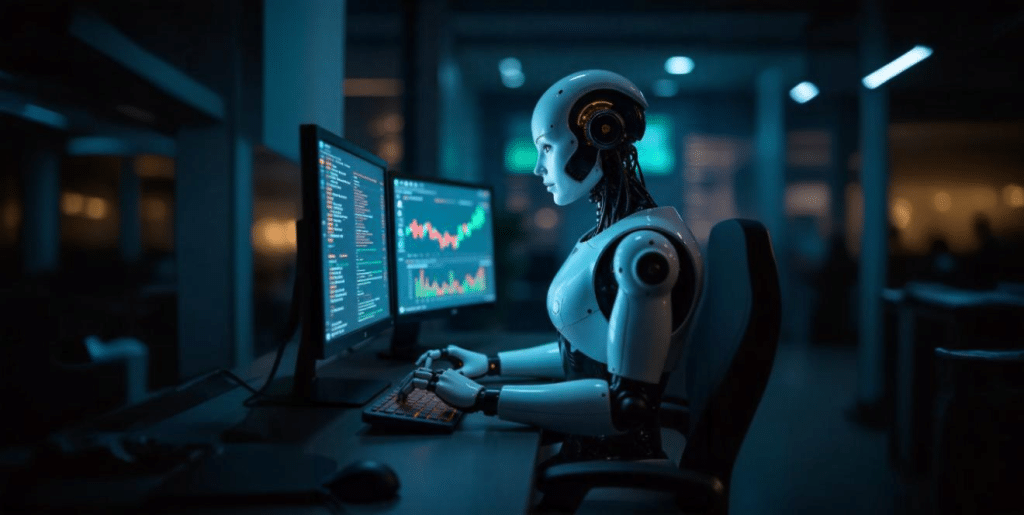
Artificial Intelligence (AI) is becoming an important part of our daily lives. From chatbots and self-driving technology to online shopping and healthcare, AI is changing the way people live and work. Many companies are using AI tools to complete tasks faster, reduce costs, and improve productivity. However, this development has raised an important question. Will AI replace jobs in the future?
The answer is not simply yes or no. AI will replace some jobs, change many existing roles, and create new career opportunities. While some workers may lose their jobs because of automation, others will find new ways to work with AI. The real challenge is to prepare people for these changes and make sure that the benefits of AI reach to everyone.
How Is AI Changing the Workplace?
AI refers to computer systems that can perform tasks that usually require human intelligence. These tasks include understanding language, identifying patterns, analysing information, solving problems, and generating content.
Today, businesses use AI to answer customer questions, prepare reports, analyse data, detect fraud, and manage routine office work. In factories, robots and automated systems help manufacture products. In hospitals, AI supports doctors by examining medical images and organising patient information.
For example, a company may use an AI chatbot to answer common customer questions instead of asking employees to handle every request. Similarly, an AI tool can prepare a basic report in minutes, while a person might need several hours to complete the same task.
These examples show that AI can reduce the time needed for certain activities. However, completing a task is not the same as replacing an entire job. Most jobs involve several responsibilities, including communication, decision-making, teamwork, and understanding human needs.
What Does the Data Say About Job Losses ?
Reports from international organisations show that AI will have a major impact on the global job market. However, it is important to understand the difference between jobs that may be affected and jobs that will actually disappear.
According to the World Economic Forum’s Future of Jobs Report 2025, employers expect that several major changes, including technological developments, will reshape employment between 2025 and 2030.
The report estimates that these changes could create 170 million new jobs and displace 92 million existing jobs worldwide by 2030. This represents a net increase of 78 million jobs. These figures are employer expectations about broad labour-market changes, not a prediction that AI alone will cause all the job losses or create all the new positions.
Another important study comes from the International Monetary Fund (IMF). In 2024, the IMF estimated that AI could affect almost 40% of jobs worldwide. In advanced economies, the share could be around 60%. Here, the word “affect” is important: some jobs may become more productive, some may change significantly, and others may face a greater risk of replacement.
These figures show that AI is likely to change employment on a large scale. They do not mean that 40% of workers will automatically become unemployed.
Which Jobs Are More at Risk?
Jobs that involve repeated, predictable, and rule-based tasks are generally more exposed to automation. AI can often perform these tasks quickly and at a lower cost.
Some examples include:
- Data entry operators: AI can collect, organise, and enter information automatically.
- Basic customer support workers: Chatbots can answer common questions and solve simple problems.
- Telemarketing workers: Automated systems can manage some routine sales calls and messages.
- Basic bookkeeping roles: Software can record transactions and prepare standard financial reports.
- Routine administrative workers: AI can schedule meetings, organise documents, and prepare simple emails.
- Some content production roles: AI can generate basic product descriptions, summaries, and standard marketing text.
However, these jobs will not necessarily disappear completely. Many organisations will still need people to check the accuracy of AI-generated information, handle unusual situations, communicate with customers, and make important decisions.
The level of risk also depends on the industry, the country, the cost of technology, and the skills required for each role.
Which Jobs Are Likely to Grow Because of AI?
Although AI may reduce demand for certain jobs, it will also create new opportunities. As companies adopt new technologies, they will need people who can develop, manage, maintain, and use these systems.
Some careers that may grow include:
- AI and machine learning specialists: These professionals develop and improve AI systems.
- Data analysts: They study information and help businesses make better decisions.
- Cybersecurity experts: They protect computer systems and sensitive information from online attacks.
- Healthcare professionals: Doctors, nurses, and care workers provide treatment and emotional support that technology cannot fully replace.
- Teachers and trainers: They guide students, explain difficult ideas, and support personal development.
- Robotics and automation engineers: They design and maintain machines used in industries.
The World Economic Forum also expects growth in areas such as education, healthcare, construction, and renewable energy. This shows that future employment will depend on both technological development and people’s basic needs.
Why Can AI Not Replace Humans Completely?
AI is powerful, but it has limitations. Human beings have emotions, personal experiences, social understanding, and the ability to build meaningful relationships. These qualities are important in many workplaces.
For example, a doctor may use AI to study a medical report, but patients also need understanding, comfort, and trust. A teacher may use AI to prepare lessons, but students still need encouragement and personal guidance.
Similarly, business leaders must consider the needs of employees, customers, and society when making difficult decisions. AI can provide information, but human judgment remains important.
AI can also produce incorrect information or misunderstand a situation. Therefore, people must check its results before using them in important decisions.
Jobs involving creativity, leadership, negotiation, personal care, and complex problem-solving may be harder to automate completely. However, these jobs can also change as AI becomes more advanced.
How Can People Prepare for an AI-Driven Future?
The best way to face changes in the job market is to keep learning. People do not necessarily need to become AI experts, but they should understand how technology affects their work.
Here are some useful steps:
- Learn digital skills: Understand common AI tools, spreadsheets, online platforms, and other technologies relevant to your career.
- Improve communication: Clear speaking, writing, teamwork, and listening are valuable in almost every profession.
- Develop critical thinking: Learn to question information, identify mistakes, and make decisions based on evidence.
- Build creativity: Try to develop new ideas and find solutions to problems that do not have simple answers.
- Keep updating your knowledge: Take courses, attend workshops, and learn new skills as your industry changes.
- Use AI as a helper: Explore ways AI can reduce repetitive work and give you more time for important tasks.
Companies also have a responsibility to train their employees and help them move into new roles when possible.
Will AI Increase Unemployment?
AI could increase unemployment in some industries, particularly when companies automate tasks faster than workers can find new opportunities. People who lose their jobs may need time, money, and training to enter another profession.
However, job creation and job losses can happen at the same time. New industries may develop, existing businesses may expand, and lower operating costs may lead to new products and services.
The final result will depend on how businesses, governments, and individuals respond. If training opportunities are available and new jobs are accessible, many workers may successfully move into different careers. If these changes are poorly managed, income inequality and unemployment could become more serious problems.
Therefore, society should not focus only on making AI more powerful. It should also focus on helping people adapt to technological change.
The Impact of AI on India
Will AI replace Jobs In India ? AI presents both opportunities and challenges for India. The country has a large workforce employed in information technology, customer service, banking, education, manufacturing, and other industries.
AI tools may automate some routine tasks in IT services, business process outsourcing, and administrative work. This could affect workers whose responsibilities mainly involve repetitive activities. Young people entering the job market may also face greater competition for certain entry-level positions.
At the same time, India can benefit from the growing demand for AI development, software engineering, data analysis, cybersecurity, and digital services. AI can also help farmers access information, support healthcare services in underserved areas, and improve learning opportunities.
The key is to prepare workers for these changes. Schools, colleges, businesses, and government institutions need to focus on practical skills, digital education, and affordable training.
Instead of fearing AI, Indian workers should learn how to use it to improve their performance and explore new career opportunities.
Conclusion
Will AI replace jobs? The most realistic answer is that AI will replace some jobs, transform many others, and create new opportunities. It is unlikely that every profession will disappear, but almost every industry may experience some level of change.
Data from the World Economic Forum suggests that 170 million jobs could be created and 92 million displaced by 2030 because of broader labour-market changes. Meanwhile, the IMF estimates that almost 40% of jobs worldwide are exposed to AI. These figures highlight the scale of change, but they do not mean that all affected jobs will disappear.
The future belongs not only to people who understand technology but also to those who can think critically, communicate well, solve problems, and adapt to change. AI should be viewed as a tool that can support human abilities rather than simply as a competitor.
Ultimately, the important question is not whether AI will replace humans, but whether humans will learn to work effectively with AI. By investing in education, developing new skills, and using technology responsibly, we can build a future in which AI improves productivity while people continue to play an essential role in society.
Check out our blog about,What is the Definition of the Business Cycle and it’s Phases?
References
- World Economic Forum, The Future of Jobs Report 2025.
- International Monetary Fund, Ai will transform the global economy. Let’s make sure it benefits humanity, January 2024.


0 Comments